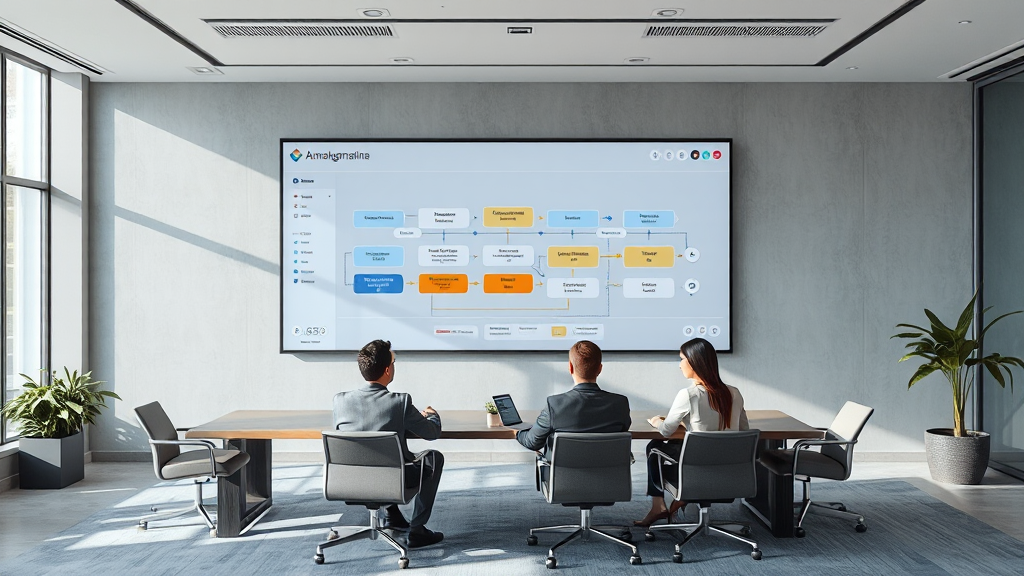
How AI Management Consulting Turns Scattered Data Into Decisive Action
Most organizations do not have a data problem in the way they think they do. They have a decision problem. Dashboards multiply, reports pile up, and yet the weekly leadership meeting still runs on gut feel and the loudest voice in the room. This is where ai management consulting earns its place: not by selling another platform, but by redesigning how decisions actually get made, then wiring AI into the workflow so the new process sticks.
That distinction matters more than it sounds. Traditional management consulting delivers a slide deck and a roadmap. AI management consulting delivers a working system — intake, classification, routing, review, and feedback loops that keep improving after the consultants leave. The output is not a recommendation. It is a running process.
Why Classic Consulting Often Stalls Before Implementation
The classic consulting model was built for a world where information was scarce and analysis was the bottleneck. Today the bottleneck has moved. Information is abundant, but it arrives in incompatible formats, lives in disconnected systems, and changes faster than any quarterly review cycle can absorb. A strategy that takes four months to produce is often obsolete before the first steering committee approves it.
There is also a structural gap: strategy teams rarely own the tools that execute the strategy. They recommend, operations implements, and somewhere in between the intent gets diluted. AI management consulting closes that gap by treating implementation as part of the analysis rather than a separate phase. If a recommendation cannot be encoded into a workflow, it is treated as incomplete.
This is why so many transformation programs quietly fail. The thinking is fine. The translation layer is missing.
What AI Management Consulting Actually Delivers
A credible engagement usually starts with a diagnostic, but the diagnostic is not the product. The product is a set of operating changes that can be measured. In practice, that means four things.
1. A decision inventory
Before automating anything, you map the decisions that actually drive value: pricing exceptions, credit approvals, escalation routing, vendor selection, staffing allocation. For each decision, you document who makes it, what information they use, how long it takes, and where it breaks down. Most organizations discover that a small number of recurring decisions consume a disproportionate share of senior attention.
2. A workflow trace
Instead of theorizing about the process, you capture it. Inputs are logged, model outputs are recorded, confidence scores are attached, and human review points are made explicit. A workflow trace turns a vague process into something you can inspect, tune, and audit. It also exposes where AI genuinely helps and where it merely adds noise.
3. Human-in-the-loop design
The goal is not full autonomy. The goal is calibrated autonomy. Low-risk, high-volume decisions can run automatically. High-stakes or ambiguous cases get routed to a person with the context already assembled. This is the difference between an AI system that people trust and one they quietly route around.
4. Measurement that survives contact with reality
Cycle time, exception rate, rework volume, escalation frequency, and decision reversal rates are the metrics that matter. They are unglamorous, but they tell you whether the new operating model is actually better than the old one.
Where AI Consulting Services Create the Most Leverage
Not every function benefits equally. In most organizations, the highest-return starting points share three traits: high volume, structured inputs, and a clear definition of a good outcome. Operations intake, research synthesis, support triage, and internal knowledge retrieval tend to fit this profile.
Consider a support organization handling thousands of tickets a week. A well-designed ai consulting services engagement might classify incoming requests, draft responses for common cases, and route complex issues to the right specialist with relevant history attached. The measurable gains are not just speed. They are consistency and reduced cognitive load on experienced staff.
Research teams see a different pattern. Instead of manually scanning hundreds of documents, analysts get structured summaries with source references, letting them spend their time on interpretation rather than collection. Sales teams get qualification signals and next-step recommendations grounded in actual account history rather than intuition.
The common thread is that AI is applied to the parts of the work that are repetitive and rule-bound, freeing people for the parts that require judgment.
Building the Business Case Without Overpromising
The fastest way to lose credibility is to promise transformation and deliver a pilot. ai business consulting that works tends to be conservative about scope and aggressive about proof. A typical sequence looks like this:
- Week 1–2: Decision inventory and workflow mapping for one high-value process.
- Week 3–4: Prototype with real data, not sample data.
- Week 5–6: Shadow mode — the system runs alongside humans without changing outcomes.
- Week 7–8: Controlled rollout with defined guardrails and escalation paths.
- Ongoing: Monitoring, retraining, and expansion to adjacent processes.
Shadow mode is the step most teams skip, and it is the step that prevents embarrassing failures. Running the model silently while humans make the real decisions gives you a clean comparison and surfaces edge cases before they reach customers.
Equally important is knowing when to stop. Some processes should not be automated. Some data is too messy, some decisions too political, some risk too high. A good consultant says so early rather than discovering it halfway through an expensive build.
The Governance Layer Nobody Wants to Talk About
AI in management contexts raises questions that pure technology vendors tend to avoid. Who is accountable when a model recommends a course of action that turns out badly? How do you audit a decision that was partly generated by a system? What happens when the underlying data drifts?
These are management questions, not engineering questions, and they belong in the operating model from day one. Practical governance usually includes documented decision rights, periodic bias and drift reviews, clear escalation thresholds, and a mechanism for staff to challenge or override outputs without penalty.
Organizations that treat governance as a compliance checkbox end up with systems nobody trusts. Organizations that treat it as a design input end up with systems that get used.
Staying current on how these practices evolve matters, which is why many leaders now follow ai news alongside their internal reviews. The regulatory and technical landscape shifts quickly, and yesterday’s acceptable practice can become today’s audit finding.
Common Failure Patterns to Avoid
After enough engagements, the failure modes become predictable.
Starting with the tool. Teams that begin by selecting a platform almost always end up fitting the process to the software rather than the other way around. Start with the decision, then choose the tool.
Ignoring the change management budget. The technology is often the cheaper half of the project. Training, communication, and process redesign consume more time than most sponsors expect.
Measuring activity instead of outcomes. Number of models deployed is not a metric. Reduction in cycle time, error rate, or escalation volume is.
Treating the pilot as the finish line. A successful pilot that never scales is an expensive experiment. Plan the expansion path before the pilot begins.
Underinvesting in data quality. Models are only as good as the inputs they receive. If the underlying records are inconsistent, no amount of model sophistication will save the outcome.
What Good Looks Like Eighteen Months In
When AI management consulting is done well, the visible changes are modest but cumulative. Meetings get shorter because the data is already assembled. Escalations drop because routine decisions are handled upstream. New hires ramp faster because institutional knowledge is retrievable rather than tribal. Senior leaders spend more time on genuinely novel problems and less on recurring ones.
There is also a cultural shift that is harder to quantify. When people see that AI is being used to remove drudgery rather than to replace them, resistance softens. When they see that their overrides are logged and respected rather than ignored, trust builds. That trust is the real asset, and it is what makes the next wave of automation possible.
Partners like Amalgama frame this as designing, testing, and implementing practical AI workflow automation for operations, research, support, sales, and internal knowledge — which is a useful reminder that the goal is not novelty. It is a business that runs better on Monday morning than it did on Friday.
Frequently Asked Questions
How is AI management consulting different from hiring a data science team?
A data science team builds models. AI management consulting redesigns the decisions those models support, including who owns them, how they are reviewed, and how the results are measured. The technical work matters, but the operating model is what determines whether anything changes in practice.
How long before we see measurable results?
For a well-scoped process, a working prototype usually appears within three to four weeks, and controlled rollout within two months. Broader organizational impact takes longer, typically six to twelve months, because it depends on adoption and process change as much as on technology.
Do we need clean data before we start?
Perfect data is not a prerequisite, but usable data is. A good engagement begins by assessing what exists, identifying the gaps that actually affect decisions, and either fixing or working around them. Waiting for perfect data is a common way to delay indefinitely.
What happens to employees whose work is affected?
In most successful programs, roles shift rather than disappear. Routine processing is reduced, and the human contribution moves toward exception handling, relationship management, and judgment. Planning that transition openly, early, and with real reskilling is part of the work, not an afterthought.
How do we know if the engagement is working?
Look for specific, unglamorous signals: shorter cycle times, fewer escalations, lower rework rates, and decisions that can be traced and explained. If the only evidence is a slide deck, the engagement has not yet delivered anything.
Final Thought
AI management consulting is ultimately a discipline of translation. It translates strategic intent into operating workflows, ambiguous processes into traceable decisions, and technical capability into measurable business outcomes. The organizations that get this right are rarely the ones with the most advanced models. They are the ones that took the time to understand how decisions are actually made — and then rebuilt that process with AI as a component rather than a headline.